What Is Proof of Delivery (POD) and Why Does It Decide When You Get Paid?
Proof of delivery (POD) is the signed document in which your customer accepts what it received. Without a clean one, your invoice is not approved for payment.
The month-end close arrives and the collections team at your distribution company reviews the account of its largest customer, a chain that buys on credit. Forty invoices for deliveries made three weeks ago have still not been scheduled for payment. The customer sent them back because it has no proof of delivery: eleven signed delivery notes are still in a truck's glove compartment, nine arrived with an illegible stamp and the rest were never uploaded to the customer's supplier portal.
Among the delivery notes is one with a handwritten note in the margin: "two boxes missing." Nobody entered it, the invoice went out for the full order and the customer held it until it received a credit note. Your company has already paid for the goods, the freight and the drivers' payroll, and the money from those forty deliveries has still not reached the bank.
The invoice that goes unpaid even though the goods arrived
Between businesses, a credit sale is collected in two stages. First the goods are delivered and the invoice is issued. Then the customer's accounts payable team compares that invoice with what its warehouse received, and only then records it for payment. Proof of delivery links the two stages: it shows what was delivered, when, to whom and in what condition.
The credit term runs from the proof
When a customer gives you thirty or sixty days of credit, the term starts on the day it accepts the invoice with its proof. Customers that work with a contrarrecibo, the receipt many Mexican companies issue when they accept an invoice for review, hand over that document in exchange for the invoice and the signed delivery note, and set the payment date on it. Every day the proof takes to travel from the truck to the collections office is added to the credit term. Your company finances that gap with its own working capital.
The proof that rides back in the cab
In most operations that use paper delivery notes, the signed sheet goes back to the warehouse with the driver at the end of the route. There it is filed in a folder and reaches collections days later. Along the way it gets wet, crumpled or lost. On an out-of-town route, the proof only comes back when the vehicle returns to its base. In the meantime, the invoice already exists in the system and the customer still cannot pay it.
What a proof of delivery needs to get you paid
Proof of delivery, often shortened to POD, can be the delivery note stamped by the customer, a copy of the invoice signed as received or an electronic record captured on a device. The format changes from one customer to another. The data that make it valid are always these seven:
An incomplete proof of delivery opens the door to disputes. A signature without a name leaves the receiver unidentified. A delivery note without quantities makes it impossible to know whether the delivery was complete.
A clean signature and a signature with exceptions
When the receiver signs without notes, it accepts that it received what the document states, complete and in good condition. When it notes a shortage or damage, it accepts the delivery with exceptions, and the invoice has to match what was actually received. If your company invoices the full order and the proof says two boxes were missing, the customer holds the payment until the correction arrives.
With electronic invoicing, correcting an invoice that has already been issued requires canceling it and issuing a new one, or issuing a credit note for the difference. Every correction made after the rejection restarts the customer's review. The same correction, made before the invoice is sent, keeps the payment on its original date.
Partial deliveries and rejections
A partial delivery or a product rejected at the dock triggers three movements: the goods that return to the warehouse, the difference on the invoice and the replacement for the customer, if applicable. If the proof of delivery records the rejection and its reason, the warehouse knows what to expect back and the sales team knows what to explain. Without that record, the difference shows up weeks later as a balance nobody recognizes.
Receipt without a claim closes the discussion
Proof of delivery also carries legal weight. Mexico's Commercial Code (Código de Comercio) establishes that the carrier's liability for losses, shortages or damage ends when the goods are received without a claim. The same code gives the consignee twenty-four hours from receipt to exercise its rights against the carrier.
For your company, this cuts both ways. If you hire outside carriers and your customer signs off on an incomplete delivery, your claim against the carrier loses its basis. If you run your own fleet, a clean signature is your best defense when the customer reports a shortage days after receiving. In both cases, what is noted or left out at the moment of delivery decides who absorbs the loss.
Paper or electronic record: where the days get lost
The signed paper delivery note
Paper works while volume is low and routes are short. With dozens of deliveries a day, each delivery note passes through several hands: the driver keeps it, the traffic manager receives it, someone scans or enters it and collections sends it to the customer. Each step adds days and a risk of loss. Handwritten notes, such as a shortage written in the margin, depend on someone reading and entering them before invoicing.
Electronic confirmation at the point of delivery
With electronic confirmation, the driver records the delivery on a device in front of the customer: quantities received, the receiver's signature, a photo and notes. The record reaches the office as soon as the device syncs, with the time and location of the signature. Collections has the proof the same day as the delivery. A shortage noted at the dock becomes an invoice adjustment before the customer rejects it.
For that confirmation to help you collect, it has to live in the same place as the order and the invoice. A transportation management system that records the delivery, separate from the system that invoices, forces someone to look up the proof in one platform and send it from another.
Five practices that shorten the path from delivery to payment
The last measurement shows where the process gets stuck. If one route takes a week to return its proofs and another hands them in the same day, the difference lies in how the route is closed. It is corrected with the driver and the traffic manager, without changing customers or carriers.
Delivery confirmed in the system that invoices
At Oasys we have spent more than 25 years developing management systems for companies in Mexico. Our Sistema de Administración Integral (SAI) brings together ERP, WMS and TMS (enterprise, warehouse and transportation management) on a single database, on our own servers in a data center. The transportation module tracks each delivery from the shipping order to the customer's signature of receipt, with direct delivery and electronic confirmation.
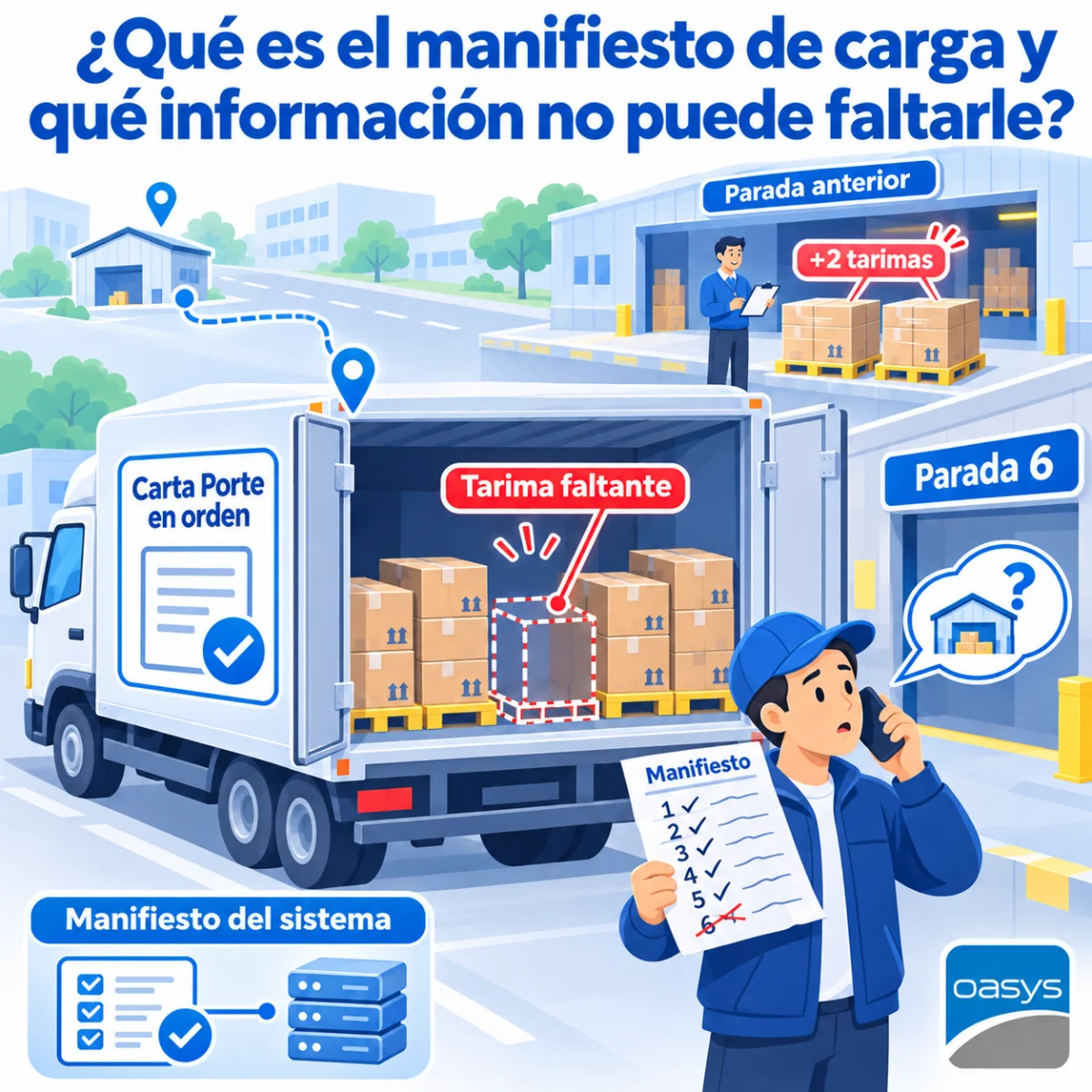
Each shipment is recorded in the ERP with its manifest, its pre-invoice and its Carta Porte. Because transportation, orders and invoicing share the same database, your collections team checks the proof of delivery for each order without waiting for the vehicle to return.
Frequently asked questions
Does a photo of the signed delivery note work as proof of delivery?
It works when it is legible and shows all the data: number, date, name, signature, quantities and notes. Before using it, confirm with each customer that it accepts that format. Also keep the original delivery note, because a dispute with the customer or with a carrier may require the signed document.
What do I do if the customer signed without exceptions and reports a shortage days later?
Review the proof of delivery together with the warehouse's picking and loading records. If the signature is clean and the picking matches the order, you have a document that proves the delivery was complete. Resolve the dispute with that proof and log the case, because repeated reports from the same receiver point to a problem in its receiving process.
Who should sign the proof of delivery at the customer's warehouse?
The person the customer authorizes to receive goods. Ask each customer for its list of authorized receivers and the stamp its warehouse uses. A signature from someone without authorization, such as a guard or an employee from another area, weakens the proof when there is a discrepancy.
If the proofs of delivery at your company reach collections days after the goods reach the customer, every route stretches your collection period. At Oasys we integrate transportation with the warehouse, invoicing and accounting on a single database, on our own servers, so every confirmed delivery is ready to collect from the day it happens. Tell us how long a proof takes today to travel from the route to collections, and we will review with you where that time is lost.
Want to see Oasys in action?
Schedule a demo with our team and we'll show you the platform with use cases from your sector.
Talk to an expert